


Fuel Prices Climb Again in Nigeria, Adding to Tinubu’s 2027 Election Challenge
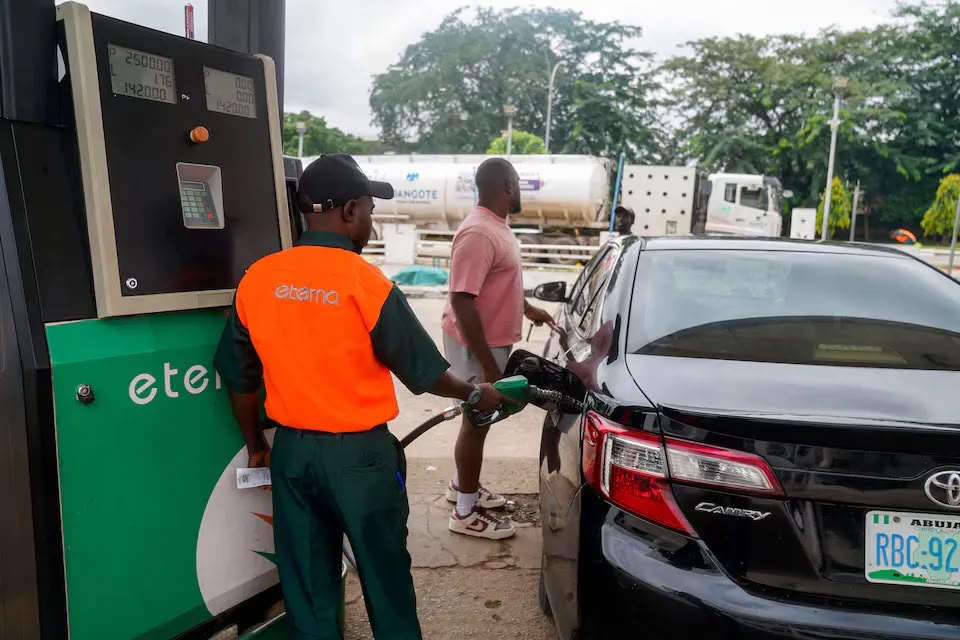
Nigeria’s fuel market has reached another uncomfortable point for President Bola Tinubu’s government. Petrol prices are climbing towards record levels, transport operators are feeling the squeeze and households are once again confronting higher daily expenses, all while the country’s much-anticipated refining revolution is operating at full capacity.
Petrol is now selling at around ₦1,400 per liter in Lagos and Abuja, up from approximately ₦1,200 just a month earlier. In parts of northern Nigeria, some filling stations are charging as much as ₦1,500, while diesel has crossed ₦2,000 per liter, Reuters reported.
Consumers are therefore dealing with more than another adjustment at the pump. Fuel sits at the center of Nigeria’s economic chain. It powers commercial transport, generators, logistics businesses and a wide range of small enterprises. When its price rises sharply, the effect can quickly spread to food prices, fares and household budgets.
“Fuel costs are eating into our earnings. After buying fuel, there is very little left for our families,” said Abuja-based truck driver Caleb Ojobo.
The Dangote paradox
The latest increase exposes a complicated reality surrounding the Dangote Industries refinery.
The 700,000-barrel-per-day facility was expected to reduce Nigeria’s dependence on imported petroleum products and make the country less vulnerable to international fuel-market disruptions. Yet the current episode shows that domestic refining does not automatically translate into cheaper fuel.
The refinery raised its petrol gantry price from ₦1,265 to ₦1,350 per liter on September 12. It was the fourth increase since August 21, taking the refinery’s price up by ₦185, or 15.9%, in just 22 days.
The reason is straightforward: the refinery still has to buy crude, and crude is priced within an international market. Tensions in the Middle East have pushed global oil prices higher, feeding directly into the economics of producing and selling refined petroleum.
That means Nigeria can refine its own fuel and still remain exposed to global oil-price movements.
This is an important distinction in assessing what the Dangote refinery can realistically achieve. Domestic refining can reduce import dependence, save foreign exchange and improve supply security, but it cannot completely disconnect pump prices from the price of crude unless other parts of the pricing structure are also insulated.
Subsidy debate returns
The latest increase has also reopened one of the most politically sensitive questions of Tinubu’s presidency: the decision to remove the petrol subsidy.
The reform was welcomed by investors and economists who argued that subsidies were expensive, distorted the market and created opportunities for arbitrage and smuggling. But consumers have experienced the policy through significantly higher fuel and transportation costs.
Tinubu has maintained that there will be no return to the subsidy regime.
With the 2027 general election scheduled for January 16, fuel prices are therefore becoming a measure through which voters and opposition politicians can judge the economic consequences of the government’s reforms.
“Fuel pricing tends to function as a proxy for the broader cost-of-living debate, and sustained increases raise the political premium on demonstrating that reform is delivering offsetting benefits,” said Jordan Lawrence, CEO of Damisa Technologies.
The central issue is increasingly whether the gains from reform are reaching households quickly enough to compensate for the immediate pain.
Inflation relief under pressure
The timing is particularly difficult because Nigeria had begun recording some improvement in headline inflation.
Inflation eased marginally to 15.39% in August from 15.43% in July, while food inflation stood at 19.57%. A renewed fuel shock risks feeding into the very categories where households remain most vulnerable.
Transporters face higher operating costs, manufacturers face more expensive logistics, traders pay more to move goods and households using petrol or diesel for generators face another increase in their monthly expenses.
The Nigeria Labour Congress has already warned that the higher costs are worsening poverty. Its president, Joe Ajaero, called for additional wage support and greater access to naira-denominated crude for the refinery.
A refinery boom, but a household squeeze
The irony is difficult to miss. As Nigerians confront higher pump prices, Aliko Dangote is simultaneously seeking public investment to expand the refinery through an initial public offering. The IPO has attracted considerable interest and is being presented as an opportunity for Nigerians to own part of a major industrial asset.
But ownership of a refinery and affordability of its products are two different questions.
Nigeria’s immediate challenge is therefore larger than simply producing more petrol. The country must find ways to make its energy reforms translate into more predictable costs for households and businesses while maintaining the market-based system the government has embraced.
The Dangote refinery has demonstrated that Nigeria can build enormous domestic refining capacity. The current fuel crisis demonstrates the other half of the equation: refining locally does not by itself protect consumers from the global oil market.
With the 2027 election approaching, that distinction is likely to become increasingly important.