

Are domestic airfares really high in Ghana?
A return flight from Accra to Tamale was selling for about US$328 for travel from October 1 to 5. For the same dates, a return flight from Nairobi to Mombasa, a journey of almost the same distance and roughly the same flying time, was US$164.
That does not mean Ghana has the most expensive domestic flights in the world. But it helps explain why passengers are asking whether flying within the country has become too expensive.
Not the highest fares, but the fastest increase
Sean Mendis, an aviation executive and consultant who helped establish Africa World Airlines and twice served as its Chief Operations Officer, says the more important story is how quickly Ghana’s fares are rising.
Using SABRE MIDT average fare data for 2024 and 2025, Mendis compared domestic routes of roughly 400 to 500 kilometres in Ghana and a number of other countries.
The representative Accra-Tamale fare rose from about US$100 in 2024 to US$125 in 2025, an increase of 25 percent.
That was the highest increase among the markets he surveyed. Istanbul-Adana rose 23 percent, Mumbai-Ahmedabad 18 percent, Nairobi-Mombasa 9 percent and Johannesburg-Durban just 1 percent. Some routes recorded falling fares.
“What is interesting however is that Ghana is showing the highest rate of increase in airfares among the surveyed markets,” Mendis said.
For him, the question is no longer simply whether Ghana is expensive.
Current fares also show that passengers can pay considerably more in Ghana than on some comparable routes.
Accra-Tamale takes about an hour. Google Flights recently listed its cheapest return ticket at US$328, including required taxes and fees.
Nairobi-Mombasa also takes about an hour. For exactly the same October 1 to 5 dates, the cheapest return was US$164.
The Kenyan route also has more competition: Kenya Airways, Jambojet and Skyward Express all operate direct services. Accra-Tamale is served by Africa World Airlines and PassionAir.
Ghana’s shorter routes are not necessarily cheap either. The cheapest Accra-Kumasi return recently found on Google Flights was US$231, while Accra-Takoradi was US$294.
These prices change constantly, so they cannot establish that Ghana is always more expensive. They do, however, show why the complaints have persisted.
CUTS International reached a similar conclusion from a different exercise.
Its September 2026 survey found return fares from Accra to Kumasi ranging from US$275 to US$522, Accra-Tamale from US$318 to US$565, and Accra-Takoradi from US$379 to US$493. Selected routes in Lagos, Nairobi and Mumbai started much lower.
But the study does not prove that Ghana has the highest domestic fares everywhere. Some European routes in the wider comparison reached much higher maximum prices.
The clearer finding is that Ghana’s cheaper seats can still be relatively expensive.
CUTS International’s West Africa Regional Director, Appiah Kusi Adomako, also cautions that high fares alone do not prove airlines are making excessive profits. Airline leases, fuel, foreign exchange, passenger numbers and other operating costs all have to be considered.
How fares moved from tax cuts to new charges
The pressure on domestic fares has moved in both directions before.
In 2017, government removed the then 17.5 percent VAT on domestic air tickets in an attempt to make flying more affordable.
Starbow’s Accra-Tamale fare fell from GH¢375 to GH¢315, while Accra-Kumasi and Accra-Takoradi dropped from GH¢315 to GH¢265.
Africa World Airlines also reduced its fares. Accra-Tamale moved from a range of GH¢375 to GH¢500 to about GH¢320 to GH¢400.
Passenger numbers between May and December subsequently rose from 295,278 in 2016 to 323,754 in 2017.
Five years later, the direction changed.
Domestic airfares increased by about 15 to 20 percent in July 2022 as the cedi weakened and aviation fuel prices surged.
Jet A-1 had risen from around US$0.60 a litre to US$1.213 by the end of July, while the cedi had depreciated about 28 percent since the beginning of the year.
A one-way Accra-Kumasi ticket could cost as much as GH¢689. Accra-Tamale averaged about GH¢642 one way, while airlines added fuel surcharges of between GH¢50 and GH¢100.
Airlines said their operating costs had doubled.
The tax relief of 2017 did not last permanently.
The Value Added Tax Amendment Act, 2023 removed domestic air travel from the list of VAT-exempt services, bringing it back into the VAT system from 2024.
The new Value Added Tax Act, 2025, which took effect on January 1, 2026, exempts domestic passenger transport by road, rail and water but does not include air travel in that exemption. Ghana’s current VAT structure is 15 percent VAT, 2.5 percent NHIL and 2.5 percent GETFund Levy on taxable supplies.
That means tax policy has again become part of the cost of domestic flying.
Then came another charge.
From April 1, 2026, every domestic ticket attracted a new GH¢100 Airport Infrastructure Development Charge for each one-way journey.
A passenger flying to Tamale and back therefore pays GH¢200 in AIDC alone.
PassionAir and Africa World Airlines both announced fare adjustments when the charge took effect.
Government says the money will be used to modernise and expand Ghana’s airports.
The charge is separate from the airline’s own cost of operating the flight.
Fuel, foreign exchange and the cost of flying
Fuel remains one of the biggest costs.
The National Petroleum Authority estimates that Jet A-1 accounts for about 30 to 35 percent of airline operating costs in Ghana.
Domestic airlines also collect most of their income in cedis but pay many bills in foreign currency.
Aircraft leases, engines, spare parts, maintenance and insurance can all require dollars. When the cedi weakens, those expenses become more costly even if the aircraft flies exactly the same route.
That helps explain why airline prices can rise even when the flying time between Accra and Kumasi remains only about 40 minutes.
Togbe Afede XIV, founder of Africa World Airlines, says Ghanaian airlines also struggle to make full use of their aircraft because of the size of the market and limitations at some airports.
“Passenger numbers do not allow for maximum aircraft utilization,” he said in remarks delivered at the arrival of AWA’s first Embraer E190.
He also pointed to foreign exchange costs, imported inputs, customs duties and airport operating hours as pressures on local airlines.
Government has also begun removing some costs.
It recently waived duties and taxes on aircraft spare parts imported by domestic airlines and has urged operators to pass the savings on to passengers.
Transport Minister Joseph Bukari Nikpe made the appeal when AWA unveiled a new 102-seat Embraer E190, which will add more capacity to its operations.
But the impact may not be immediate. Aviation analyst Dr Dominic Andoh says passengers could begin to see some easing over the coming months as airlines adjust to lower spare-parts costs and other changes.
More passengers, two airlines and limited capacity
Mendis believes another problem sits on the supply side.
“We have seen domestic capacity in Ghana remain largely flat over the last few years even though demand has increased significantly,” he said.
Domestic passenger movements increased from 862,727 in 2024 to 903,227 in 2025. Aircraft movements rose from 19,243 to 20,208 over the same period. In the first six months of 2026, domestic passenger movements had already reached 523,682.
Aircraft movements do not tell the whole story because different aircraft carry different numbers of passengers. But the figures show that demand remains strong.
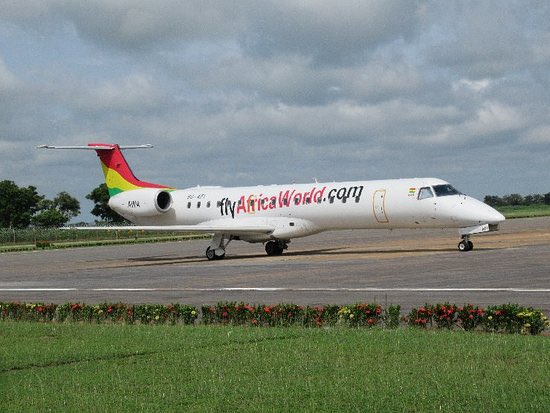
Ghana’s scheduled domestic market is now largely shared by Africa World Airlines and PassionAir.
Mendis argues that this matters.
“However, in a duopoly situation as currently exists, there is little incentive for the incumbents to change this,” he said.
Two operators do not by themselves prove price fixing or collusion. But fewer airlines mean fewer seats and less competition than on routes such as Nairobi-Mombasa, where several carriers compete for passengers.
Adomako makes a similar point, but cautions against treating the number of operators as evidence of wrongdoing.
“Two airlines do not prove collusion or abuse, but fewer independent rivals reduce the pressure to discount, innovate and pursue marginal passengers.”
He has called for conditions that would make it easier for new airlines to enter the domestic market and increase competition.
Togbe Afede, however, points to the difficult history of operating domestic airlines in Ghana.
“When AWA started in 2012, several domestic airlines existed; none survived,” he said.
Mendis believes Ghana still needs more capacity and argues that more seats could ease the supply bottleneck and slow, or even reverse, the pace of fare increases.
The Accra-Tamale fare rose 25 percent between 2024 and 2025, faster than every other market in Mendis’ comparison.
The cheapest return fare currently available on that route can also be about twice the price of Nairobi-Mombasa, despite the journeys being similar in distance and duration.
Behind the ticket are taxes, the new GH¢100 airport charge, fuel, dollar-denominated maintenance costs and a market where demand is growing but scheduled domestic services remain concentrated between two airlines.
Ghana’s domestic fares may not be the highest everywhere.
But they are rising quickly, and for passengers paying several thousand cedis to save a few hours on the road, that distinction may offer little comfort.