

Xi Jinping’s Egypt Visit Sends a Powerful Message to the United States
Chinese President Xi Jinping’s arrival in Egypt has taken on significance far beyond the symbolism of a state visit. His first trip to the Arab world’s most populous country in a decade comes at a moment when governments across the Middle East are reassessing their security partnerships, economic dependencies and diplomatic options following the fallout from the Iran war.
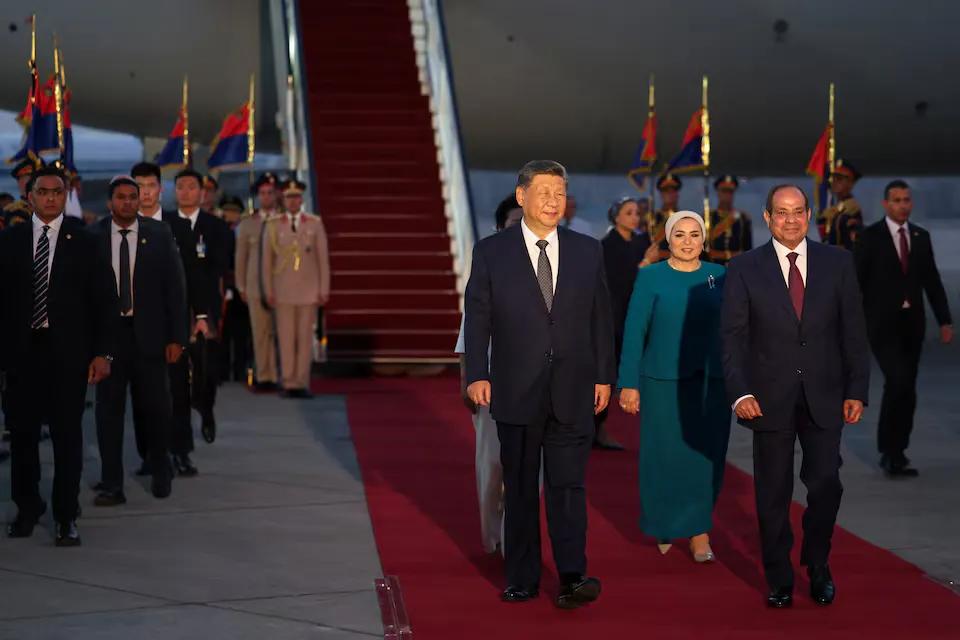
Egyptian President Abdel Fattah al-Sisi’s welcome at Cairo International Airport was deliberately ceremonial. Xi walked a long red carpet alongside Sisi as uniformed soldiers, folk dancers and young Egyptians waving Chinese flags greeted the Chinese leader, Reuters reported. But behind the spectacle lies a much more consequential message: Cairo is increasingly comfortable cultivating Beijing as a major strategic partner while maintaining its longstanding relationship with Washington.
Sisi captured that ambition in an op-ed published by Egypt’s state newspaper, Al-Ahram, describing Egypt and China as partners working to strengthen the influence of the Global South in the international system.
That language reflects a foreign policy increasingly built around diversification rather than dependence.
For decades, Egypt has remained firmly within the American security orbit. Cairo receives roughly $1.3 billion annually in US military assistance and has relied heavily on American diplomatic and military support. Yet the wars in Gaza and Iran have complicated perceptions of Washington’s reliability across the region.
Egypt’s experience suggests that maintaining a close relationship with the United States does not necessarily mean relying on it exclusively.
“Egypt sees itself as moving toward greater strategic autonomy,” said H. A. Hellyer of the Royal United Services Institute. “It wants strong relations with Washington, but also Beijing, Moscow, and Europe.”
That strategic calculation is becoming increasingly visible in the military sphere.
Last month, Egypt held its second annual military exercises with China, signaling a relationship that is moving beyond trade and infrastructure. The exercises included the deployment of China’s J-16 fighter jets to Africa for the first time and an unusual air-combat drill involving the Chinese aircraft and French-made Rafale fighters.
Chinese state media also highlighted images of a Chinese air force tanker refueling a Rafale, providing Beijing with an opportunity to study a sophisticated Western-designed aircraft while demonstrating the growing sophistication of military cooperation between Egypt and China.
The exercises matter because Egypt occupies an unusually important position in the regional security architecture. It borders Israel, Sudan and Libya and controls the Suez Canal, one of the world’s most important maritime trade routes. Instability anywhere along its immediate neighborhood can quickly become an Egyptian security or economic concern.
China has increasingly recognized that strategic value.
China’s economic footprint in Egypt has expanded rapidly, with Chinese capital entering manufacturing, ports, renewable energy, green hydrogen and satellite technology. The relationship therefore offers both sides something valuable. Egypt gains investment, technology and another source of diplomatic and military cooperation. China gains a foothold in a country connecting Africa, the Arab world, the Mediterranean and the Red Sea.
“Egypt was an obvious choice” for Xi’s visit because of its connection to so many regional issues, according to Eric Olander, co-founder of the China Global South Project.
The timing also matters diplomatically. Xi’s visit follows his meeting with Jordan’s King Abdullah in Beijing, where Palestinian rights featured prominently. Beijing has increasingly sought to position itself as a political actor in Middle Eastern affairs, particularly on the Palestinian question, even as Washington remains the region’s dominant external military power.
Egypt’s relationship with China is therefore not simply a story about replacing America. Cairo has little incentive to abandon Washington, particularly given its military assistance and longstanding security ties. Instead, Egypt appears to be pursuing a classic hedging strategy: keep the United States close while building enough relationships with China, Russia and Europe to reduce vulnerability to any single power.
China, meanwhile, has an opportunity to pursue that approach. It does not need to displace the United States overnight. By expanding economic, technological and military cooperation with strategically important states such as Egypt, China can gradually strengthen its influence.
Xi’s visit consequently represents more than a diplomatic reunion between two countries that established relations seven decades ago. It is a snapshot of a Middle East undergoing a broader strategic adjustment.
As wars expose the risks of depending on one security partner and economic uncertainty pushes governments to widen their options, Egypt is betting that influence in the next phase of regional politics will belong not to countries that choose one camp, but to those capable of dealing with several competing powers at once.