


Iran War Puts BRICS Unity to the Test as India Hosts Key Summit
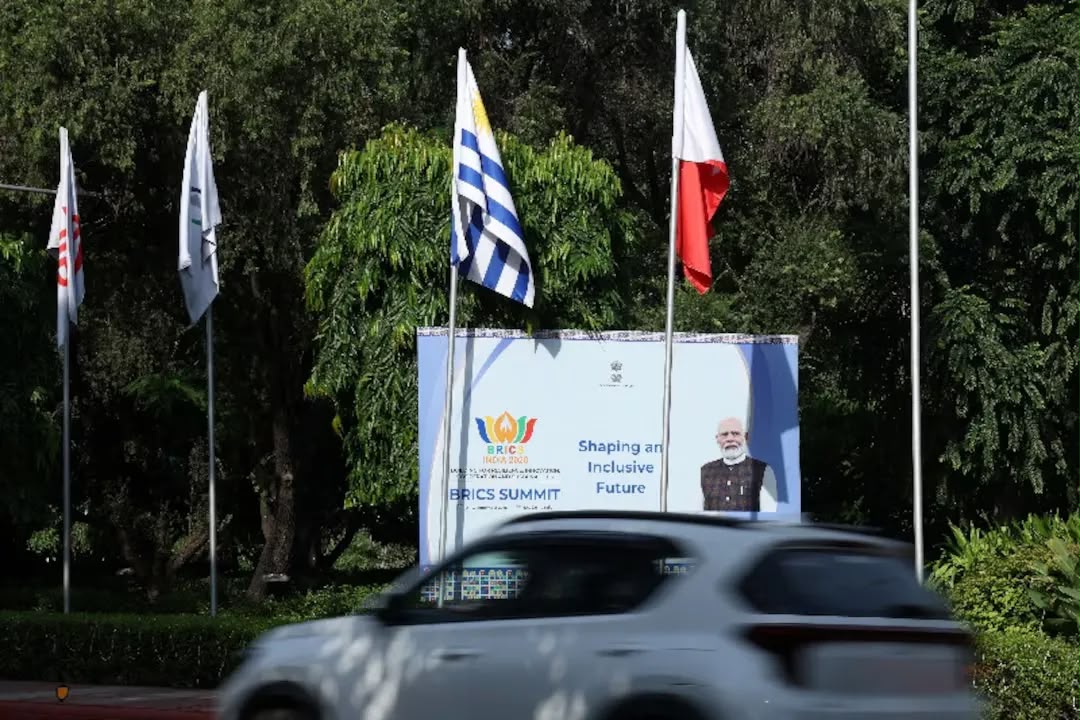
India is reportedly preparing to host the BRICS Leaders’ Summit in New Delhi on September 12 and 13, but the gathering comes at a difficult moment for a group that has spent years presenting itself as an increasingly influential voice for the Global South.
The expanded bloc now includes countries with sharply different strategic interests, and nowhere is that divide more visible than in the Middle East. Iran, which joined BRICS in 2024, and the United Arab Emirates are now on opposing sides of a conflict that has disrupted regional trade, energy markets and diplomatic relations.
The U.S.-led war on Iran, which followed attacks by the United States and Israel more than six months ago, has added a serious complication to India’s attempt to use the summit to strengthen BRICS’ international standing. The conflict has contributed to a virtual shutdown of the Strait of Hormuz, a critical passage for global oil supplies, sending crude prices above $100 a barrel.
The UAE’s own position has become particularly difficult. After Iranian missile attacks since the beginning of the war, the UAE suspended trade and financial transactions with Iran in August.
That dispute could directly affect one of the most important outcomes of the New Delhi summit: whether BRICS can produce a joint declaration.
A bigger BRICS, but a harder BRICS to manage
The problem confronting India goes beyond the Iran-UAE disagreement.
BRICS was initially built around Brazil, Russia, India, China and later South Africa. Its subsequent expansion brought Egypt, Ethiopia, Iran, the UAE and Indonesia into the grouping, giving the bloc a broader geographic reach and strengthening its claim to represent the interests of emerging economies.
But expansion has also introduced competing foreign-policy priorities.
Iran and the UAE have fundamentally different positions on the current conflict. Egypt and Ethiopia have their own disagreements. Saudi Arabia’s position is also still uncertain, with Riyadh yet to formally accept full membership while continuing to participate at a lower level.
That makes consensus increasingly difficult.
Michael Kugelman of the Atlantic Council has described the situation as an irony for BRICS: its expansion demonstrates its growing appeal, but the differences among its newer members could simultaneously make the organization less effective.
The warning is not theoretical. In May, BRICS foreign ministers meeting in New Delhi failed to produce a joint statement because of disagreements between Iran and the UAE.
The leaders now have to avoid repeating that failure.
Finding language everyone can live with
The immediate challenge is therefore diplomatic rather than military. BRICS is unlikely to alter the course of the Iran conflict, but the wording of its declaration could reveal how much political weight the bloc has actually acquired.
Kremlin spokesman Dmitry Peskov acknowledged that tensions between Iran and the UAE were having a negative impact on efforts to draft a joint declaration. Still, Russia believes the leaders could find language acceptable to both sides.
There is a possible precedent.
Earlier this month, the Shanghai Cooperation Organization summit produced a declaration on the Iran conflict that was acceptable to countries with differing positions. Indian Prime Minister Narendra Modi, Chinese President Xi Jinping, Russian President Vladimir Putin and Iranian President Masoud Pezeshkian were among those who backed the statement.
That experience has given Indian officials some reason for optimism.
Former Indian diplomat Rajiv Bhatia argued that the SCO outcome showed that countries with different strategic orientations could still reach a common formulation. The complication, however, is obvious: the UAE is not part of the SCO.
BRICS must therefore find a formula that accommodates Abu Dhabi as well as Tehran.
China and Russia add another layer
The summit will also be significant because of the leaders who are attending.
Xi Jinping’s visit to India will be his first in seven years, underlining Beijing’s interest in BRICS and placing China alongside India at the center of efforts to keep the enlarged grouping together.
Xi’s expected meeting with Modi could be particularly important. India and China have been working to stabilize relations following tensions along their disputed Himalayan border, and another meeting would provide an opportunity to discuss economic ties as well as the broader direction of their relationship.
Putin is also scheduled to meet Modi ahead of the summit, with trade and economic cooperation expected to dominate discussions.
That relationship carries economic and geopolitical significance. Russia remains one of India’s major energy suppliers, while New Delhi continues to face pressure from Washington over its purchases of Russian oil.
The timing is even more interesting because Xi is expected to travel to the United States later this month. Any interaction between Xi and Putin in New Delhi could therefore attract considerable attention.
BRICS wants influence, but unity is the real question
The summit ultimately presents BRICS with a paradox.
The grouping is larger, more geographically diverse and arguably more important than when it was created. Yet that very expansion has made consensus harder to achieve.
U.S. protectionism and unilateral tariff policies have also created common economic concerns among BRICS members, potentially giving them additional reasons to coordinate.
But economic frustration with the West is not enough to erase disagreements between members.
India’s biggest achievement in New Delhi may therefore not be a dramatic new initiative. It may simply be getting Iran and the UAE to stand behind the same diplomatic language.
If BRICS manages that, it can claim that its expansion has strengthened rather than weakened its ability to act collectively. If it fails again, the summit could expose the central weakness of the bloc: BRICS may be growing faster than its members’ ability to agree on what that growth should mean.