


Mark Cuban Predicts Humanoid Robots Will Fail Within 10 Years
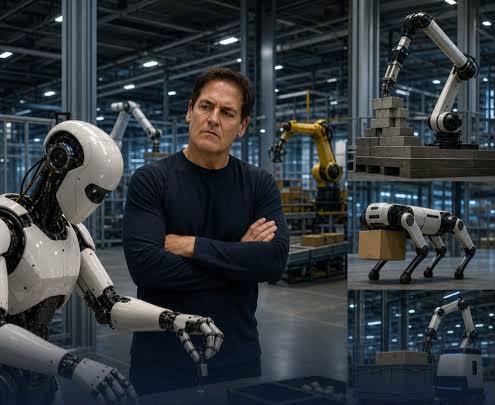
Billionaire investor and entrepreneur Mark Cuban has predicted that the current push to develop humanoid robots could fail within the next five to 10 years.
Cuban shared his view during an interview on the TBPN podcast, where he discussed artificial intelligence, robotics, self-driving technology and the future of work.
His argument is not that robots will disappear. Instead, Cuban believes the industry may move away from machines designed to look like humans.
According to reporting by Tech Yahoo, Cuban argued that humanoid robots may not be the most practical or efficient solution for most jobs. He suggested that companies could achieve better results by building machines designed specifically for particular tasks.
A robot used in a warehouse, for example, may not need two legs, two arms and a human-shaped body. A machine designed to move boxes could use wheels, tracks or another shape that allows it to work faster and more efficiently.
Cuban believes this could eventually lead to buildings and homes being designed around specialised robots. Rather than forcing robots to operate in spaces built for humans, engineers could create environments that match the machines they want to use.
StationLM, which published an analysis of the interview, described Cuban’s idea as a form of “co-design.” Under this approach, the robot and the environment would be developed together. A delivery machine might use a particular type of doorway, while a cleaning robot could be designed to move through specially built spaces.
The prediction comes at a time when companies are investing heavily in human-shaped machines. Tesla is developing its Optimus robot, while other technology and robotics companies are working on machines intended for factories, warehouses, healthcare facilities and homes.
Cuban’s criticism focuses partly on cost and practicality. Humanoid robots require advanced motors, batteries, sensors, balance systems and software. They also need to perform safely in unpredictable environments.
A report by Axios noted that humanoid robots still face major technical challenges, especially when they must use their hands to handle delicate or irregular objects. Human fingers can apply different levels of pressure and adjust quickly to objects, while robotic hands remain expensive and difficult to develop.
Cuban also believes that purpose-built robots already demonstrate the value of specialised design. Warehouse machines, robotic vacuum cleaners and automated factory systems can often perform narrow tasks more effectively than a general-purpose human-shaped robot.
His prediction is controversial because other technology leaders are optimistic about humanoid machines. Companies developing the technology believe human-shaped robots could eventually work in places already designed for people, including factories, homes and offices.
The human form has one major advantage: the world is built around it. Stairs, doors, tools, vehicles and workstations are generally designed for people. A humanoid robot could therefore operate in existing spaces without requiring every building to be redesigned.
However, the cost and complexity of copying the human body could also become a weakness. A specialised machine may be cheaper, easier to maintain and more reliable for a specific job.
The coming decade will show whether human-shaped robots become common in homes and workplaces or whether companies choose simpler machines designed for individual tasks.
For now, Cuban’s warning challenges the assumption that the best robot must look like a person. His central argument is that successful robotics may depend less on copying the human body and more on designing machines that perform specific jobs well.